AI Kanban vs Traditional Kanban: The Ultimate 2026 Comparison
Understand how intelligent automation, predictive analytics, and dynamic workflows elevate agile project management beyond static sticky notes.
Executive Summary
Traditional Kanban relies on manual human oversight to track movement and identify bottlenecks. AI Kanban augments human intuition with machine learning algorithms that forecast delivery delays, auto-categorize backlog items, and dynamically optimize work-in-progress limits in real-time.
1. Introduction to Agile Workflow Evolution
For over two decades, the Kanban board has stood as a cornerstone of agile software development and lean operations. Originating from Toyota's manufacturing floors and digitized by countless software tools, traditional Kanban visualized work, limited work-in-progress (WIP), and maximized continuous flow. However, as engineering teams scale across distributed environments, static digital sticky notes often lead to administrative drag, manual status meetings, and undetected workflow blockages.
Enter Artificial Intelligence. Modern project management software, exemplified by platforms like FlowUpBoard, integrates machine learning, natural language processing, and predictive analytics directly into visual workflows. This evolution gives rise to AI Kanban—an intelligent paradigm that automates routing, predicts delivery dates, and dynamically adapts team capacity.
2. What is Traditional Kanban?
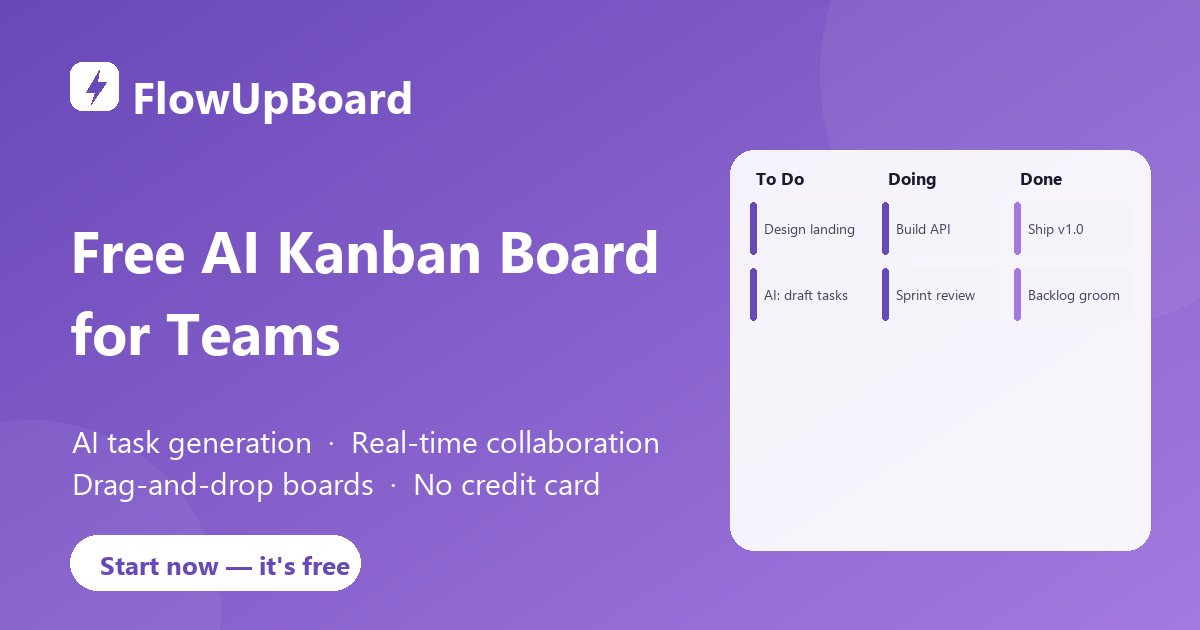
Traditional Kanban is an agile visual management method focused on continuous improvement and smooth workflow delivery. It utilizes columns representing distinct stages of work (e.g., Backlog, In Progress, Code Review, Testing, Done) and cards representing individual tasks or user stories.
Key Characteristics of Traditional Kanban
- Manual Card Movement: Developers or project managers manually drag cards across columns as work progresses.
- Static WIP Limits: Teams establish fixed caps on how many cards can occupy a column simultaneously (e.g., maximum 3 items in Code Review).
- Lagging Metrics: Lead time and cycle time are calculated retroactively after tasks reach completion.
- Human-Driven Triage: Standup meetings are required to verbally identify blockers, assign ownership, and re-prioritize backlog items.
3. What is AI Kanban?
Definition: AI Kanban
AI Kanban is the next-generation evolution of visual workflow management that combines the core principles of lean flow with artificial intelligence to eliminate repetitive administrative tasks and provide data-driven foresight.
Within platforms like FlowUpBoard, AI Kanban analyzes historical team velocity, code repository commits, pull request statuses, and communication patterns to transform static boards into intelligent, self-regulating ecosystem models.
Key Capabilities of AI Kanban
- Predictive Analytics: Estimates completion dates with confidence intervals based on real-time developer throughput.
- Dynamic WIP Limits: Automatically adjusts column capacity limits based on team member availability, time-off schedules, and task complexity.
- Intelligent Task Routing: Automatically assigns incoming bug reports or feature requests to the developer with the most relevant domain expertise and available bandwidth.
- Autonomous Blocker Detection: Flags stale cards sitting untouched in review stages and notifies designated owners via Slack or integrated messaging channels.
4. Core Differences: Feature-by-Feature Comparison
| Feature / Metric | Traditional Kanban | AI Kanban (FlowUpBoard) |
|---|---|---|
| Card Movement | 100% manual drag-and-drop by team members. | Automated triggers via CI/CD, PR merges, and NLP parsing. |
| WIP Limits | Static numbers set manually during agile retrospectives. | Dynamic limits adjusted by AI based on team bandwidth and task size. |
| Bottleneck Detection | Identified reactively during daily standup or retrospective meetings. | Identified proactively in real-time with automated alerts. |
| Delivery Forecasting | Based on historical averages and subjective estimations. | Calculated via machine learning models analyzing commit frequency and complexity. |
| Backlog Grooming | Manual prioritization, tagging, and duplicate removal. | AI-powered summarization, auto-tagging, and duplicate clustering. |
| Administrative Overhead | High (requires constant manual status updates). | Minimal (AI handles status synchronization and reporting). |
5. How AI Kanban Works Under the Hood
Understanding the architectural mechanics of AI Kanban clarifies why it delivers such a profound leap in engineering efficiency. Modern AI project management platforms leverage a multi-layered computational stack:
- Data Ingestion Layer: Connects securely with version control systems (GitHub, GitLab, Bitbucket), continuous integration pipelines, and communication tools (Slack, Teams) to aggregate real-time developer activity signals.
- Natural Language Processing (NLP) Engine: Analyzes incoming issue descriptions, feature requests, and bug tickets. It automatically categorizes severity, tags modules, and estimates story points based on historical semantic similarity.
- Machine Learning Forecasting Models: Uses regression and time-series analysis to calculate probabilistic delivery dates. If a developer runs into an unexpected snag, the model instantly recalculates sprint burn-down projections.
- Prescriptive Automation Engine: Executes conditional workflows without human macro-management, ensuring cards transition effortlessly as code progresses from branch creation to production deployment.
Expert Tip
When migrating from traditional boards to an AI Kanban tool like FlowUpBoard, allow the machine learning engine at least two weeks of historical commit and movement data ingestion to calibrate accurate delivery forecasts.
6. Practical Examples & Scenario Analysis
To ground these concepts in reality, here are practical scenarios illustrating the operational differences between traditional and AI-driven Kanban workflows.
Scenario 1: Developer Absence
Traditional: Tasks remain trapped; team discovers roadblock during standup.
AI Kanban: Detects missing check-in, recommends reassignment to available engineers.
Scenario 2: Code Review Bottleneck
Traditional: Cards pile up indefinitely until a senior engineer notices.
AI Kanban: System notifies secondary reviewers when cycle time exceeds threshold.
Scenario 3: Story Point Estimation
Traditional: Hours spent in poker-planning meetings debating estimates.
AI Kanban: NLP evaluates similar tickets and suggests evidence-based valuation.
Scenario 4: Backlog Duplication
Traditional: Manual scanning and merging of duplicate tickets.
AI Kanban: Semantic clustering detects duplicate tickets instantly.
Scenario 5: Stakeholder Updates
Traditional: Manual status report generation every week.
AI Kanban: Executive summaries delivered on demand from real-time data.
Scenario 6: Sprint Retrospectives
Traditional: Relying on subjective developer memory.
AI Kanban: Data-driven bottleneck analysis and objective velocity metrics.
7. Real-World Case Studies
To demonstrate the tangible impact of adopting intelligent workflow management, here are five enterprise case studies from organizations utilizing FlowUpBoard.
FinTech Scale-Up
40% faster release cycles, cycle time reduced from 14 to 8.4 days
Automated compliance checks and predictive cycle-time analytics
Enterprise SaaS Provider
70% reduction in standup duration, 300+ hours reallocated monthly
AI-powered status synchronization and automated blocker notifications
Healthcare IT
Zero non-conformity findings in ISO-27001 audit
Automated git-commit verification linked to Kanban workflow columns
E-Commerce Retailer
65% output scaling during peak holiday preparation
Dynamic WIP limits and intelligent onboarding task allocation
Mobile App Studio
Forecast accuracy improved from 58% to 95%
ML forecasting models analyzing historical commit velocities
8. Best Practices for Adopting AI Kanban
- Start with Clean Data: Ensure repository naming conventions and issue descriptions are clear so the AI natural language engine can parse them effectively.
- Calibrate WIP Limits Gradually: Allow the AI engine to recommend dynamic WIP adjustments before locking down strict automation rules.
- Empower the Team: Train engineers and product managers to interpret AI predictive analytics rather than viewing them as rigid mandates.
- Integrate CI/CD Pipelines Early: Connect your version control systems immediately to unlock automated card progression.
9. Common Pitfalls & How to Avoid Them
Common Mistake: Over-Automating Too Quickly
Enabling all automated card movements and strict AI routing on day one often overwhelms team members. Introduce automations iteratively—starting with notification alerts before moving to automated status transitions.
- Ignoring Human Context: Relying solely on AI metrics without considering qualitative team feedback during retrospectives.
- Neglecting Backlog Hygiene: Assuming the AI can fix poorly written, ambiguous user stories without clear acceptance criteria.
- Resisting Workflow Transparency: Hiding bottlenecks instead of using AI analytics to address systemic blockers head-on.
10. Technical Implementation & Automation Config
Configuring AI Kanban rules in modern platforms like FlowUpBoard is streamlined through declarative configuration files or intuitive natural language builders. Below is an example of an AI automation workflow configuration:
version: '2.6'
board:
  name: "Core Engineering Pipeline"
  type: "AI-Kanban"
  automations:
    - trigger: "pull_request.merged"
      conditions:
        repository: "main-backend"
        branch: "release/*"
      actions:
        move_card: "Testing & QA"
        notify_assignee: true
        calculate_cycle_impact: true

    - trigger: "card.stagnant"
      threshold_hours: 48
      actions:
        flag_blocker: true
        alert_channel: "#engineering-alerts"
        suggest_reassignment: true
11. Future Trends in Intelligent Project Management
As we look further into the decade, project management software is shifting toward fully autonomous orchestration. Key trends include:
- Generative UX Interfaces: Boards that dynamically reorganize columns and layout configurations based on the user's specific role (developer vs. executive).
- Autonomous Refactoring Agents: AI agents that not only track tasks on the Kanban board but also draft boilerplate code fixes for identified bugs.
- Cross-Organizational Portfolio Intelligence: Enterprise-wide predictive modeling that aligns engineering Kanban boards directly with corporate financial targets.
12. Summary & Conclusion
Traditional Kanban boards remain a vital historical foundation for visual workflow management, but they struggle to keep pace with the velocity and complexity of modern software engineering. AI Kanban represents a quantum leap forward—replacing manual administrative friction with intelligent automation, predictive forecasting, and real-time bottleneck detection.
By adopting platforms like FlowUpBoard, software developers, scrum masters, and enterprise leaders can eliminate meeting fatigue, accelerate release cycles, and focus on what truly matters: building exceptional products.
Want the full picture of how an intelligent board runs end to end? Our AI Kanban workflow explained guide covers forecasting, dynamic WIP limits, and a 5-step implementation plan.
13. Frequently Asked Questions
Experience the Benefits of AI Kanban Today
Join thousands of teams using FlowUpBoard to deliver faster, plan smarter, and ship with confidence.
Start Your Free Trial